On Monday, I will be sharing with the school board my goals and accomplishments for the 2018-19 school year. I have had a good year. Actually, may just be one of the best years of my entire 23-year career! Below is the presentation that I will be sharing that demonstrates some fairly significant milestones for 2019.
Jen Hegna – 2019 Goals <—- Click this to expand presentation With hyperlinked artifacts
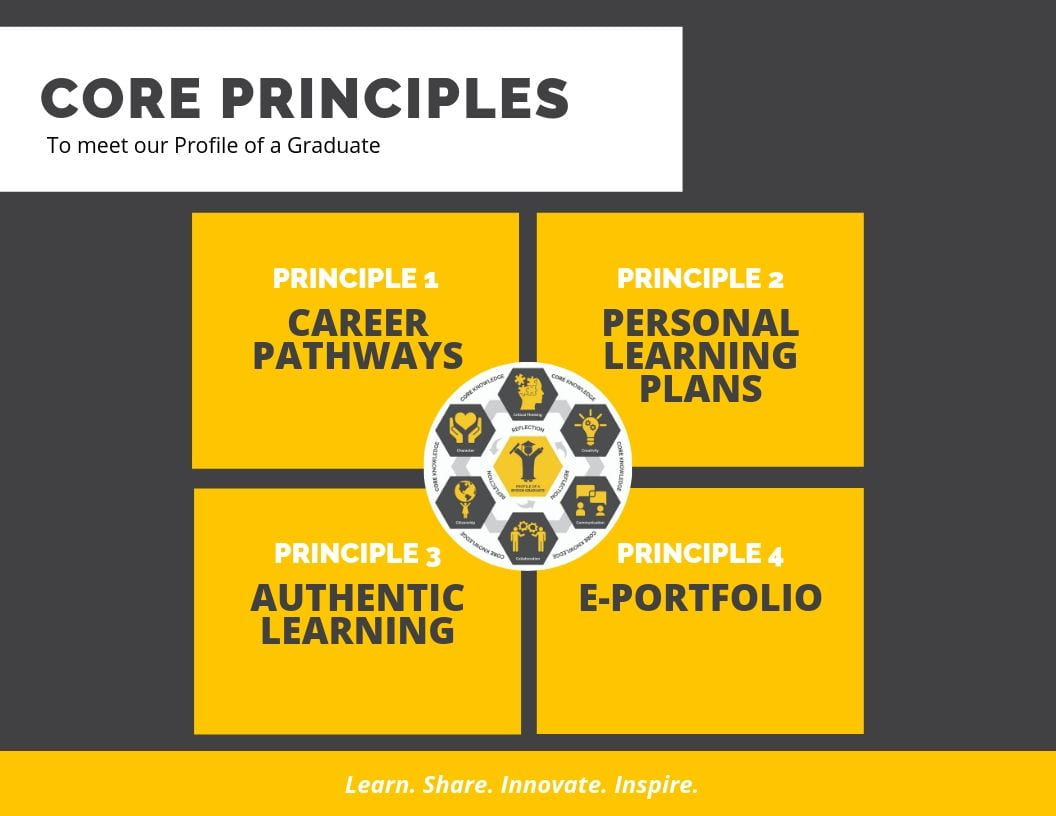
At the same time, I am currently reading a book by Silvia Rosenthal Tolisano and Janet Hail called A Guide to Documenting Learning: Making thinking visible, meaningful, shareable, and amplified. With our Profile of a Graduate (PoG) rollout next year, ePortfolios is one of the core principals to meet our district’s PoG. (see below) While we have had K-12 ePortfolio’s for several years, the implementation has not been as good as I had hoped. Next year, we are implementing a new ePortfolio system for grades 6-12 (WordPress). One of my goals for 2019-20 is to Revisit and refine ePortfolio’s 6-12, provide training, and make standard practice. I felt it was time to look for resources that could help improve the system/process and I do believe this book is a keeper!
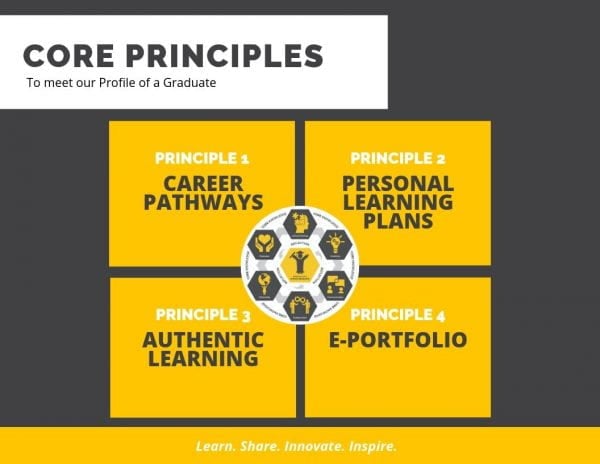
BHS – Core Principles to meet the District’s Profile of a Graduate
To apply some of what I am reading, I am going to use my Goal Work (evidence of learning) with the process of documenting OF, FOR, and AS learning to better make my thinking and learning visible.

Simply documenting the evidence of learning is what is seen. However, there is power in the thinking and the process that led to that evidence or what will happen because of that learning evidence. How do we make the invisible visible?
Documenting OF learning: Focuses on the product and attempts to answer these following questions: (p. 6)
- What did the learner do?
- What was the result of learning?
My Goal Work – Document OF Learning:
Within my evidence of learning (preso), I have 8 goals listed. For each of those goals, I have created a slide that documents the evidence of meeting those goals. Its been a busy but good year of learning! As you go through the presentation, you will see the results of my work that includes statistics (data), websites, documents, infographics, presentations, and videos. While you might assume there was depth in thinking and learning when creating each artifact – without the context of what I did, why I did it, it only scratches the surface of my learning. The authors share that at this level- it feels like busy work. <—– Hint this is incredibly important for the rollout of next year. We have reflection built into our ePortfolio – but this little tidbit might help with buy-in. Will be critical for training!
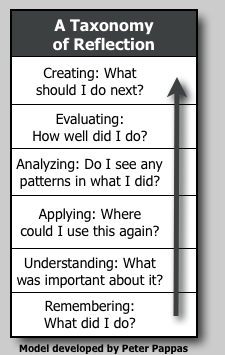
A Taxonomy of Reflection by Peter Pappas
Documenting FOR Learning: Focuses on the interpretation of learning -(p.8)
“This type of learning asks learners to interpret, reflect on, and connect artifacts along a learning journey this type of documentation makes visible that which the learners are not even aware of and provides time to interact with and examine artifacts to make connections and discover trends.”
- How is what I am learning now related to something I have previously learned
- How will this learning influence and inform future learning?
- Why do I accept this artifact as evidence of my learning process and progress?
- How could someone else learn from my experience – both failures and my successes?
- What would I need to do to best capture my learning today and at the end of the year related to ____ for me to see and hear evidence of my growth over time?
My Goal Work – Document FOR Learning:
We have a very exciting vision of education in Byron that is going to provide our students with experiences I wish I would have had, my kids could have had (they all have graduated) but maybe, just maybe, my grandkids WILL have. The arrows are aligning to that vision and systemic changes are being formed. This is big. Aligning arrows. Having a strategic plan, and then requiring buildings/departments to create goals to meet those priorities seems simple right? It’s not that simple. Just having a strategic plan on the wall without creating action plans to meet your vision will most likely leave you with pockets of innovation. Where some students get to have the experiences your strategic plan desires. But what about ALL students? And having the Technology Plan goals in the District Operation Plan? BINGO.
Over this past year, I have been working to improve my communication skills – specifically around our district’s branding/storytelling. I have produced a boatload of content this year. Writing grants, press releases, graphics, videos, marketing materials, websites, presentations all highlighted in my goal presentation. I can Canva like a boss! But I also have been working with tools like Final Cut Pro, Illustrator, Photoshop, ect. I’d like to get better at Illustrator and the Adobe Production tools. I would like to get to advanced levels of Final Cut Pro. I have some video ideas in the works and will continue to challenge myself! My final reflection about communication? Clarity. Going down the path of implementing our Profile of a Graduate is complex – will need a variety of materials to explain the process. I tried this with our BHS PoG plan. However, this still is fairly complex for the general public and will require more materials – like video – to help with the key messages.
For the first time ever, I will be presenting my goals to the board. Yes, that makes us accountable! However, I also intended on publishing my goal work online. I appreciate getting feedback and learning from others and feel I can also contribute to the learning of others. Well, audience certainly matters – even for tech directors – and I wanted to demonstrate some of the branding skills within my goal presentation.
Document AS Learning: focuses on the learning process and attempts to answer the following questions: (p. 11)
- What is worthy of being looked for and captured during this learning opportunity?
- What media platforms and tools will provide the maximum effect for capturing, reflecting on, curating, sharing, and amplifying my personal learning or the evidence of other’s learning?
- How can my/our thinking be best-conveyed visibly and audibly when considering the audiences who will be experiencing my shared and amplified learning?
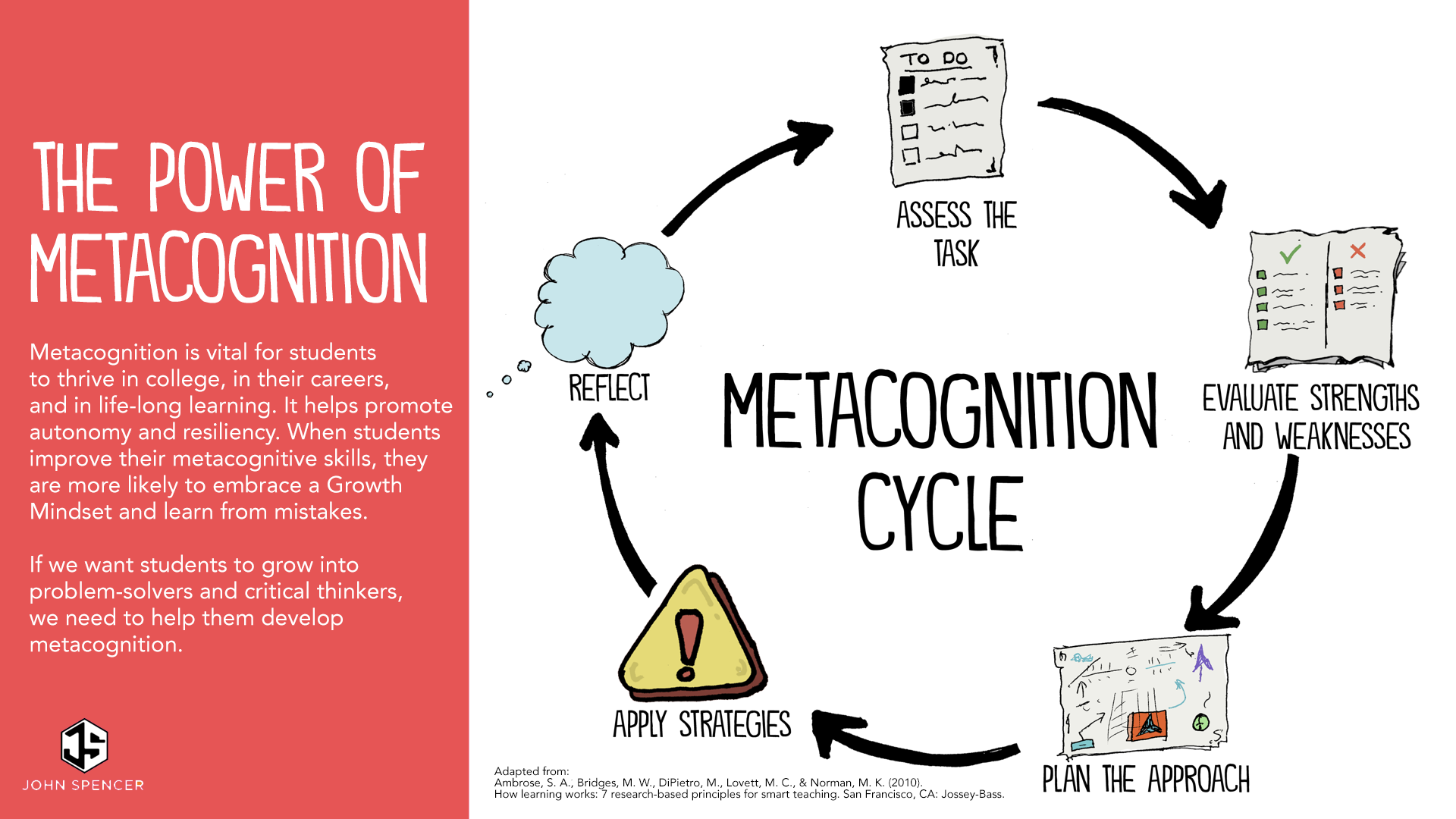
The Metacognition Cycle – via John Spencer – http://www.spencerauthor.com/metacognition/
My Goal Work – Document AS Learning:
As I shared, I have a goal next year around ePortfolios. I want to revamp the rollout/training with our new blog system Right now, I am learning about documenting learning to meet that goal for NEXT year. As I was reading the text, I kept on thinking about my current goals, and how I could apply this thinking to my own work. As I shared earlier – I knew I was going to publicly post my goals, why not knock out 2 birds with one post! 🙂 Because I need feedback on my thinking, I chose my blog to help amplify my learning. I will be publicly tweeting this out, tagging a few of my friends, tagging the authors of this book, and utilizing the hashtag #document4learning to find others who may be reading this book as well. Eventually, this thinking is going to be moved into some sort of PD – Target August!.
So there you have it! Its been a great year but there is still so much work to do. I believe this post demonstrates my understanding of documenting of, for, and as learning. If not, please reach out to me! All in all, this has been a great exercise in thinking and I need to pause, think, publish more often. Hmmm. Maybe podcast?
Looking forward to 2020!
Resource
Tolisano, Silvia Rosenthal., and Janet A. Hale. A Guide to Documenting Learning: Making Thinking Visible, Meaningful, Shareable, and Amplified. Corwin, 2018.






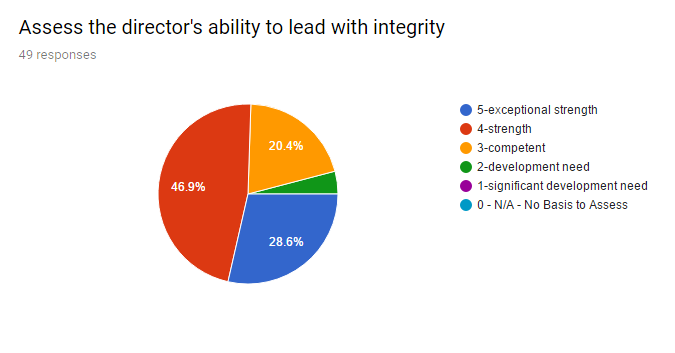
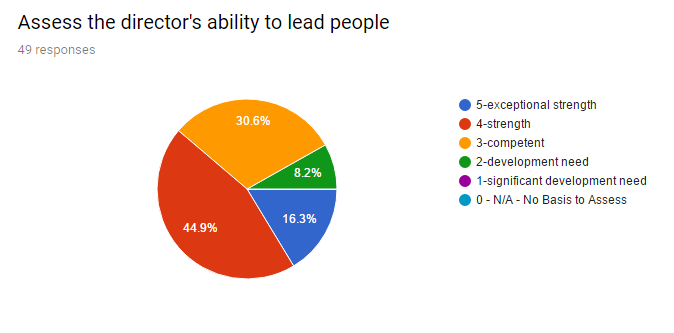
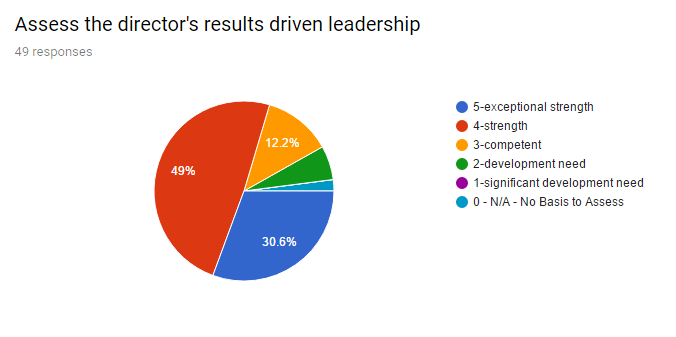
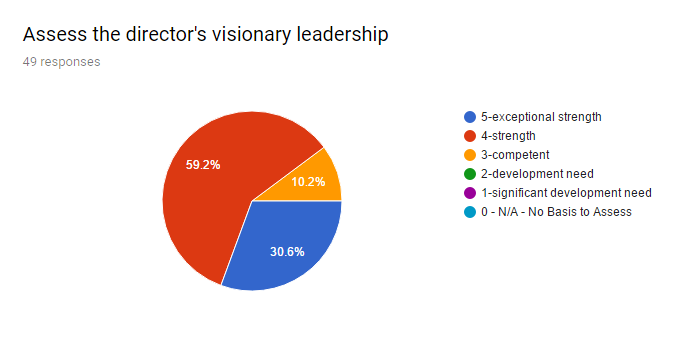
 Accountability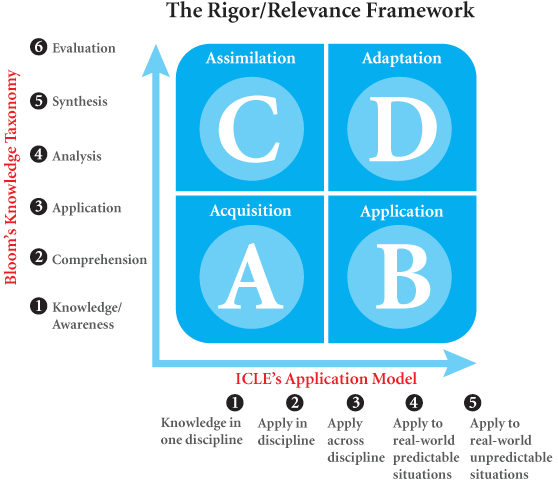

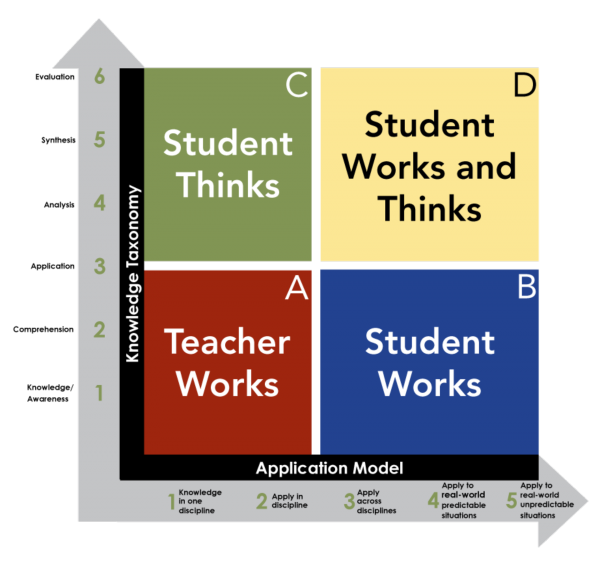 While we have been focusing on deeper learning this year, what I like about this framework is it provides a scaffold of these types of learning environments. Sheninger said while our goal should be to get our students to quadrant D, it is impossible to reside there at all times. In my opinion, It is also not fair to kids to provide them with an education that never allows them to move out of Quadrant A. As I was perusing the leadered website, I did stumble on the